Kim Bruce gratefully acknowledges the grant support from the A.F.A. to produce the work in the Heels series.
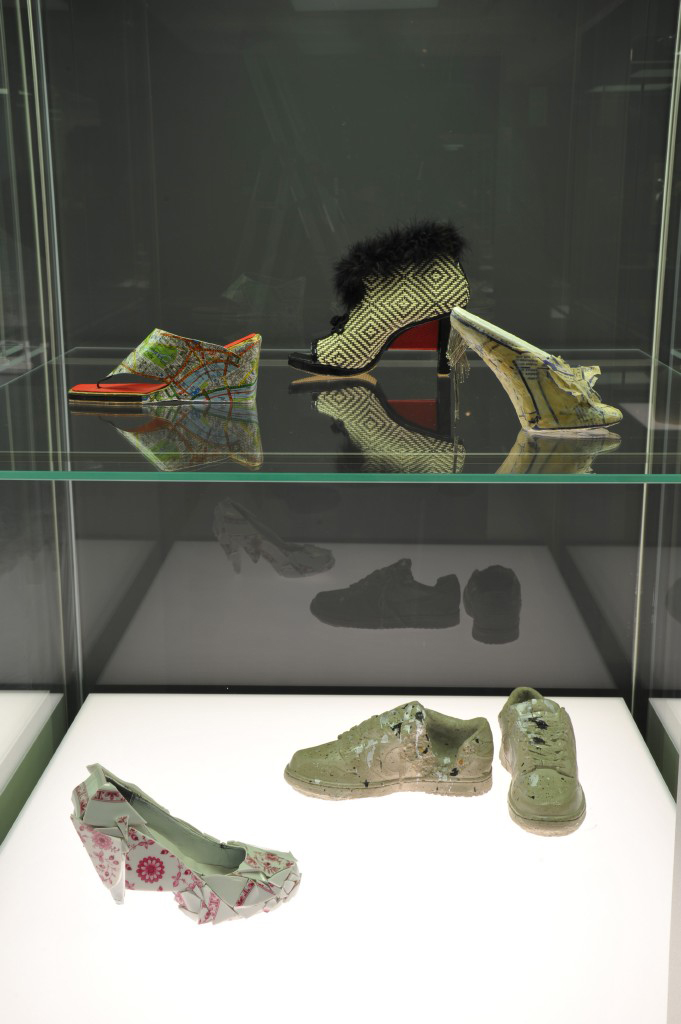
Step Lightly, Cast encasutic, pins & needles,vintage dressmaker pattern, 5″ x 2.5″ x 7.5″
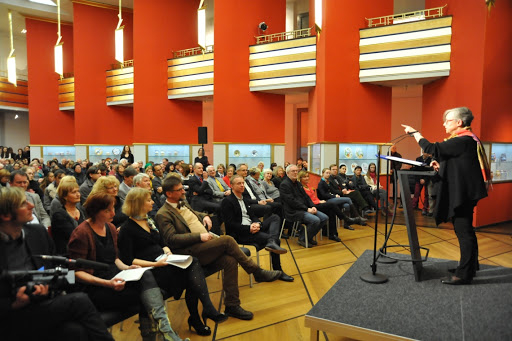
The Grassi museum presents: Over a 100 fascinating and surprising footwear creations from around the world. The selection shows the architecture in miniature shoes, shoes with socio- critical potential, with historical referenced shoes or shoes that are not obvious at first glance. The exhibition is complemented by photos and videos of shoe performances.
World renowned artists, architects and designers such as Keith Haring and Zaha Hadid have rediscovered the shoe itself. They present the amazing and bizarre, and provide a variety of aesthetic and cultural aspects. The range of materials used is far reaching: futuristic high-tech fabrics, ceramics, wood, glass, elephant dung, paper and of course leather and fabric were used as the starting material. Portable or not? The original and ingenious designs are unlimited. It’s all about the shoe as an art form, to be reshaped as sculpture.
As I get to know more artists I’m finding that not only do some have day jobs but another passion outside of their art.
I have found doctors, engineers, welders and technical drafts-people. What’s fascinating to me is that these disciplines are considered left brain while art on a whole is consider right. You know, math and science.
Personally I don’t think that creativity is limited to one brain hemisphere. Einstein was very creative.
I wonder if by keeping these other careers private we are trying to live up to the artistic mystic. When in fact they may add credibility to another wise known flaky artist. OR is it the other way around? Admitting the you are a doctor, lawyer or an accountant means you’re not a serious artist?
Well these are points to ponder and I imagine you have good arguments for both.
As for me, I freely admit that I LIKE COMPUTER CODE! As they say in the WordPress world “code is poetry”. My other passion is over at Artbiz.ca
SO DO YOU THINK IT A BAD CAREER MOVE AS AN ARTIST TO EMBRACE YOUR OTHER SIDE AND COME OUT OF THE PROVERBIAL CLOSET?
Thanks to Lori Zebier whose admission inspired this post.
I am very proud to have 2 pieces juried into this exhibition. Please join me at Lougheed House September 9 from 1:30 to 3:30 or September 16 from 10:00 to 1:00.
So I have kind of an ironic story about a studio accident I had with these pins I use so much in my art.
I was snipping some with wire cutters and try as I may to contain the pieces some went here and there around my studio floor.
One stray went straight into the bottom of my heavily soled studio shoes. Unaware I carried it around with me until it was time to take off my shoes. My shoes are backless so I just kick them off using my other foot. Using the foot that already had the shoe removed I kicked the back of the other shoe to remove it. Missing; my foot slipped and I stabbed myself in my big toe with the stray pin. Ouch! Hopped around a bit and thought nothing of it and went to bed.
Next day the big toe hurt even more and two days later the big red streak appeared. I was infected! What the heck? I prick myself with pins all the time.
Off to the doctor thinking I was going to have to have my toe lanced. All he gave me was antibiotics and suggested that the pin had some bacteria on it.
A few days later while taking my daily look at my unfortunate big toe to see how the infection was receding; I noticed a tiny pin head (pun intended) size dark spot, hum. So I mustered up some courage and placed an ice pack on my toe for 10 minutes to numb it. Then I got a needle, tweezers and some alcohol swabs, disinfected them and held my breath.
I opened the sore and called my husband; this was a two person job. While I held back a piece of skin he was able to grab a hold of the dark spot (which we thought was just dried blood or something), pulling out a 3/8” (I measured it) piece of pin; the pointy part.
The body is an amazing thing; it was trying to eject this foreign object from my toe. My big toe feels so much better now, thank you.
The irony is that while I am using pins and needles to make an artistic statement about what stilettos can do to harm your feet, this very item ended up harming my foot.
Do you have a studio accident that you survived to tell the story?
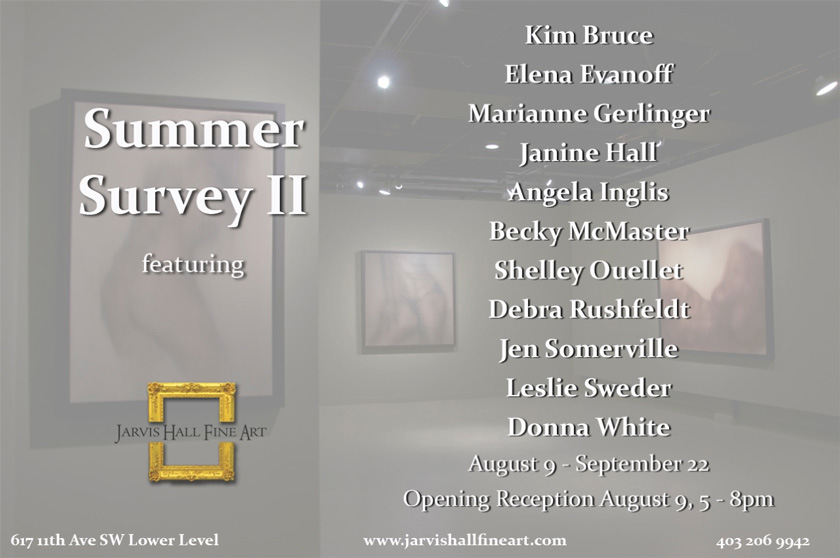
It is time again for me to have a look outside of our regular roster of artists and curate an exhibition inviting artists that I admire to hang on our walls. Last August our first Summer Survey Bring The Noise was a great success and a point of conversation throughout the year with collectors and artists alike. It is in this spirit of thought provoking exhibitions that I present to you Summer Survey II, featuring:
Paintings by Janine Hall (courtesy of the Weiss Gallery), Becky McMaster, Elena Evanoff, Marianne Gerlinger and Leslie Sweder. Drawings by Debra Rushfeldt. Sculpture by Donna White, Kim Bruce , Jen Somerville and Shelley Ouellet. Photographs by Angela Inglis.
We are not having a title for this year’s summer survey show. I had intended to come up with a clever or insightful title referencing the fact that all of the exhibiting artists are women. I have decided that gender is not the point of this exhibition at all. The art is, as it should be, the thing. During studio visits I realized that while the energy was coming from a feminine place the impact of the work did not rely on this information. I was encouraged as a curator, to realize that I was looking at commanding artworks. To say that I am attempting to curate an exhibition that opens a feminist dialogue would be wrong. This exhibition is an honest survey of what is happening in the studios of artists that I admire. The hope is for the audience to be inspired by the variety of vision these artists bring to this exhibition.
It is hard time consuming work to write a grant application especially for a visual person to whom words do not come as naturally as imagery. But if you’re willing to invest the time you will find that there are all sorts of benefits even if you are not successful. The least of which is that you will know yourself and your work that much better and may come out of it with one hell of an artist statement.
I don’t think there is a magic formula to writing a grant proposal. You just have to write as if the jurors know absolutely nothing about you or your work. We are so close to our work that it can be difficult to remove oneself and talk about the project as if the reader knows nothing about you. Things that are obvious to you may not be to the jury.
Here are some things that may help you write your grant proposal.
Do not try to make the grant program fit what you want to do. You as the applicant and your proposed project must meet the program eligibility guidelines
Allow several weeks to prepare your application in order to research costs and logistics, draft a timeline/schedule, book equipment or space rental, gather support materials, and so on.
You can apply early. As long as your proposal has been mailed in prior to your commencement date, you can start even though the deadline may be a few months away. I applied in December in order to start in January but the deadlines wasn’t until February.
Create a Table of Contents in your draft application document to ensure you include all required information.
Write down thoughts as they occur to you. Little snippets of ideas can really help you formulate your proposal and they can come to you when you’re doing something else.
Keep a notebook by your bed so you can jot thoughts down.
When preparing the budget I was told that it helps if you contribute financially to the project. For example in my budget I included travel to and from the exhibition as part of the projects budget but did not ask for that amount.
Have someone proof read and not just for punctuation but for comprehension.
The AFA (Alberta Foundation for the Arts) has a really good General Tips document that helps you formulate your outline and write your prose.
These 4 questions from the grant tips really helped me get clear on what I need to write about.
What you are you doing stylistically, technically, etc. to realize your “artistic vision” for this project?
Will your project lead to technical as well as aesthetic challenges?
Does this new project mark an artistic departure from your previous work?
Or does this project build on and develop further your artistic activity to date?
If you follow the tips and organize your outline exactly as they have laid out it will remove a lot of confusion and provide some structure to work within.
I had a couple of things in my favour for this particular grant application. First, I already had an exhibition scheduled for the work I was going to produce. And second, I will be the only Canadian (Albertan) artist in this international exhibition.
I put emphasis on these 2 points when writing my proposal. It probably also helped that the exhibition has a curator.
If you are writing a grant, even if it for another institution, the A.F.A. General Tips document will probably help you understand and organize your proposal. They also have a great Digital Images Tip document for photographing work and a budget example to use as a template. All are available to download from the AFA’s website.
Kim Bruce gratefully acknowledges the grant support from the A.F.A. to produce the work in the Heels series.
I met Bev Tosh in the early 90’s as a student in her figure drawing class at the University of Calgary. Later I attended her figure painting workshop at Series in Red Deer – twice. When I left my design business to pursue my art career full time an opportunity came available for studio space with Burns Visual Arts Society. Bev is one of the founding members of BVAS and I was honoured to have my studio space in the same building as her’s.
My tenure at BVAS was 4 1/2 years during which time I met some pretty amazing artists and made some great friends. I would still be there today if I hadn’t moved away from Calgary. I miss the creative energy of BVAS.
In 2007 I had the privilege of showing with Bev and our dear friend Elizabeth Clark (1947-2008), in our exhibition “Home Bodies” at Profiles Public Art Gallery in St Albert.
For me as emerging artist, this was a milestone and an exhibition that I will always be proud of.
Home Body Exhibition
Bev also provided me with the opportunity to work on her first WarBrides.com website when I was just starting Artbiz.ca. We recently converted the old HTML site over to WordPress so that Bev could add and maintain her content. But more than that – At the time I was developing the WordPress Help site for artists and Bev generously acted as my editor, going through each tutorial one by one and offering feedback and telling me where to insert my commas (I’m really bad with commas).
Bev was very generous with her time; in fact Bev is simply a very generous person, period. Her work with the war brides is nothing short of profound. Collecting the stories and painting portraits about these amazing women who gave up life as they knew it to venture forth to a new country, Bev has captured the essence of a generation.
War Brides, Otago Settlers Museum Dunedin, New Zealand
As a documenter and artist, Bev has single handedly become a historian and lecturer about war brides. Her exhibition “One Way Passage” has been shown as far away as New Zealand and she is currently working on a Dutch War Bride exhibition. For little or no monetary gain other than honorariums, Bev funds the travel, insurance and crating of her work.
Passion is just one of the best words that I can use to describe Bev. That and modest; she achieved R.C.A designation with little fanfair. R.C.A. is an acronym for Royal Canadian Academy, one of the highest honours for a Canadian Artist.
I once heard someone in the arts community say that Bev’s pursuit of the War Brides work was a career killer. I was shocked because I have always been under the impression that success as an artist wasn’t about the money but truth. Truth of concept, truth in passion, truth of self. If you sit and talk with Bev you will experience what passion is, what it looks like in someone that has it and aspire to reach that level of belief in yourself and your work.
So while we are all pondering where our next sale is going to come from, perhaps we could define what it is to be an artist. When I moan and groan over my lack of commercial sales I think about what Bev has accomplished and ask myself what does my success as an artist really mean?
March 3 to April 15, 2012
Opening reception March 2 at 6:00pm Dade Art & Design Lab
1327 9 AVE SE
Calgary AB
403 454 0243
I started the “Off the Wall” series to study form. Removing the figure which you typically see in my work allowed me to work with form, colour and design in the purest sense. This is the first series that I really bring in the use of colour.
My work has always been stronger when the individual pieces can relate to each other. My mind wants to work in a capsule on an isolated structure. Each piece becomes precious, on to itself. Then when grouped the whole becomes the sum of its parts.
Installing the pieces in a group with the negative space flowing through and around the objects reinforces the individuality of each piece. Rather than framing which would contain the pieces forcing them to be one; with installation and use of negative space each piece remains an individual while working as a whole.
More and more you see calls to artists where there is a $25 to $35 submission fee. I have also seen some that are asking for $10 per image submitted. This fee doesn’t guarantee that you are in the show only that you can submit.
I have also noticed that alot of calls state that you the artist, have to incur the cost of shipping the work to and from the gallery. I found this from a website call:
“Shipped works must be sent in an easily reusable container/packaging with return shipping prepaid, and include the return shipping label with the work.”
I get it that in order to survive that some galleries need to levee these charges especially artists run centers.
I was juried into a The Sculptors Society of Canadian a few years ago. They are based in Toronto and I live in Alberta. In order to show in the gallery I have to pay a $50 submission fee as well as pay for the transport of my work there and back. This is a great group and a lovely gallery and I get it that they don’t have a lot of funding. For a venue like this perhaps it would be alright to participate and pay the submission fees maybe once a year???
I still don’t think artists should have to pay submission fees to show their work! I have always had a policy never to pay submission fees to exhibit my work especially not to a vanity gallery.
Do you pay submission fees to galleries to show your work?
I am a great lover of books both for their content and their aesthetics. Books have been around me for my entire life. My Mother is a big reader and has custom built book shelves in her home.
I daydream about writing a book although I’m not sure what that looks like in words. Mine is a visual language.
Books provide knowledge and ideas, but what if you could not access that knowledge. What if it was taken away? No you can’t turn to the internet that is not what this is about.
These altered books act as my canvas and present themselves as the keepers of knowledge. Vaults. Unreachable. Inaccessible.